How well can a Blue Jay *really* imitate a Red-Shouldered Hawk? Caught these two on video today. Thought the Hawk was flirting with another hawk til the Jay showed up!!
Sunday, December 31, 2006
Ever heard a Blue Jay imitate a Red-Shouldered Hawk?


10 feet tall and bullet proof!
Had a visitor to the yard today….a beautiful Cooper’s hawk! Needless to say, every bird in sight disappeared instantly…except for the juvie male Rufous hummer who guards the end of my driveway. He was divebombing the hawk if it moved, and cussing at it incessantly for as long as it was there. Fortunately it had its eyes on other things (house sparrows) and couldn’t be bothered with this tiny feisty morsel!
The dive-bombing in this video doesn’t show…but you can hear him cussing in the background (turn up the sound, but cover any tender ears in the room—such language, tsk tsk!!) http://dgpatterson.com/janebirds/CoopVsRufous.wmv
And here’s a closeup of the tough guy. Does he look 10 feet tall and bullet proof to you??? http://dgpatterson.com/janebirds/rusty_hum_side_good.wmv
Friday, December 29, 2006
They do eat bugs, they do, they do, they do!
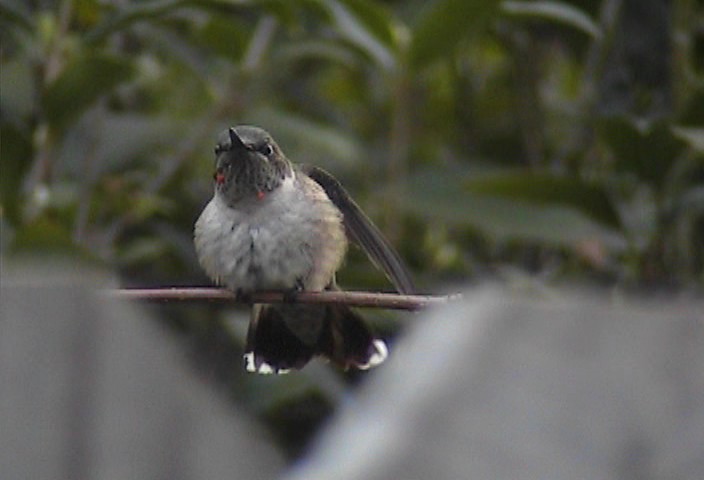

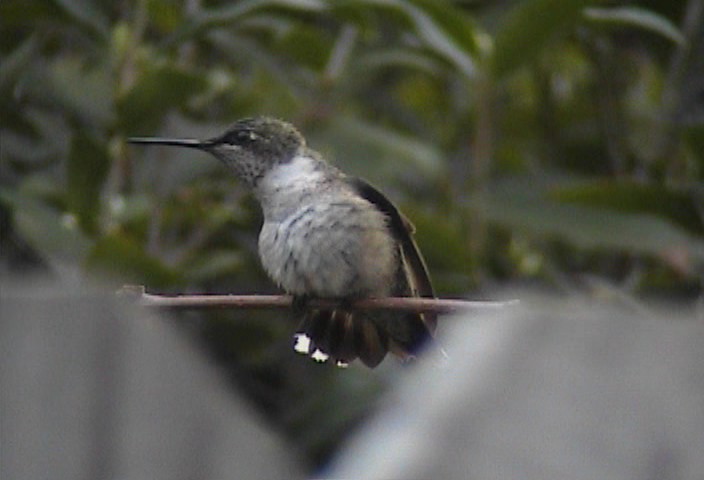
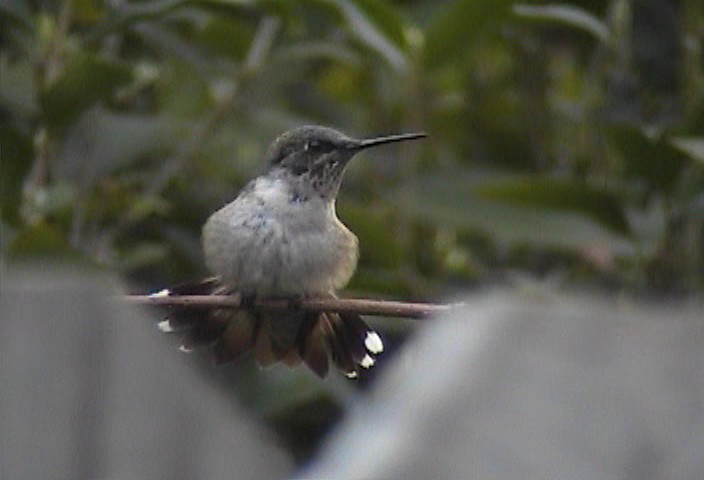
There were some postings recently on humnet (listserv for humnuts) regarding whether or not hummers are flycatchers to any significant degree. I don't think there's really a debate...I believe it's been ruled by examining stomach contents that they are, but it's rare to actually witness them at it. I was watching this little hummer today -- he's an overwintering juvenile male Ruby-Throat --and I caught him in action! You can even see the insect he's after! Some times it pays to be patient :-)
The short version of the video: http://dgpatterson.com/janebirds/Hum_Flycatching_short.wmv
The longer version of the video: http://dgpatterson.com/janebirds/Hum_flycatching.wmv
And a neat short clip of a great stretch and tail flare… http://dgpatterson.com/janebirds/R2_tail_flare.wmv
Sunday, December 17, 2006
Sorting out winter hummers...
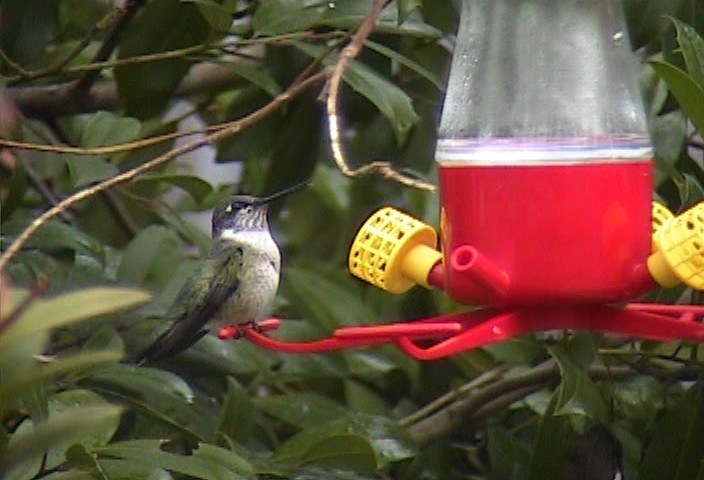 I'm trying to sort out the hummers that have visited me so far this winter, or at least the ones I've managed to photograph. There appear to be six distinct birds:
#1 - The first winter bird was an adult female Sel R/A with a distinct triangular gorget and a lovely bracelet on her left leg. Since
#2 - I have another Sel R/A that has a
#3 – I am pretty sure this is a third Sel R/A. The coloring and the gorget looks different to me than my #1 bird. Also see no evidence of band. http://dgpatterson.com/janebirds/3rdRuf_close.wmv
#4 – I observed #4 and #5 on the same day. Or rather…I knew I had a bird that was not a Sel R/A but I hadn’t sorted it out yet. When I did manage to get a picture, two birds showed up! I call #4 “Fatty” because it’s, well, fat. J It also has a single reflective gorget feather to the lower right so I’ve been able to ID it by that (not definitive, I know, but raises probability with so few birds around). I think it might be a Ruby-throat, although it’s the mildest-mannered one I’ve seen. Twice I’ve seen it allow other birds on “his” feeder. His feather’s get ruffled but he rarely rants or take action. Very laid back bird, for a hummer. http://dgpatterson.com/janebirds/driveway_hum2.wmv
#5 – First observed this bird when it visited the feeder that #4 was guarding! He has a distinct 5-oclock shadow, but no reflective feathers in it that I can see. http://dgpatterson.com/janebirds/hums_4and5_121306.wmv This is a closer look at just #5 http://dgpatterson.com/janebirds/nonRuf_shadow_VG.wmv
#6 – This last one is definitely not a Sel R/A, nor is it the same bird as either #4 or #5 because her throat is completely clear – no shadow or gorget feathers in sight. I’d say she’s either a RTHU or a Black-chinned. http://dgpatterson.com/janebirds/clearthroat_good.wmv
Saturday, November 11, 2006
Geese! Thousands and thousands of geese...
You read about this stuff, or even watch it on tv, but it's much more impressive to actually *be* there!
We visited the ricefields below Rayne, LA last weekend and came across a substantial group of "speckled belly" geese (formally known as Greater White-fronted) and Snow Geese, both in the white form and blue morph form. Pretty darn spectacular!
A great gaggle of geese
Monday, October 16, 2006
Birding class
I've been taking an Intermediate Birding class through LSU Union Leisure classes. Richard Gibbons is the instructor, although he's brought in guest speakers. The class is focused on birds that are more difficult to ID, like fall warblers, hawks, sparrows, and shorebirds. We've done field trips to the rice fields and a couple to the Miss River levee. Picked up a few lifers along the way, but few pictures or video.
I've also been down to New Orleans to City Park, which is an overgrown jungle right now and not a particularly safe place to be. It's also hard to get around between trees down over trails and a year's worth of growth reclaiming the area.
I participated in the Big Sit on October 9. Justin and Devin Bosler did this last year and again this year in the spring and wanted to continue the effort. Basically, a group stakes out a 17-foot diameter circle somewhere and counts all the birds they can see from that location. The Boslers have chosen a spot at Richfield Riversilt. Last year they could see the river pretty well, but this year the successional growth blocked much of the view. They counted 88 species even so, which is not bad at all, and only 3 shy of their list last year. They started at about 4:15am and lasted until 7:30 pm. I arrived at 8:30 or so and stayed til 7:00pm. There were only 4 people and another half dozen would have really helped to be able to scout around the area and point things out to the circle sitters.
A common migrant for us right now is the Magnolia Warbler. It looks a lot like other warblers, but is easily distinguished by the underside of the tail, which has white undertail coverts, with large black tips -- making the tail look half white, half black. A feature easily seen in this video. I can see how this could be confused for a Yellow-rumped Warbler because it also has a yellow rump patch, but the underside of the tail clinches it.
Magnolia Warbler
Tuesday, September 19, 2006
More madness!

Dick Lancaster sent an email saying he had even more birds this week, if I wanted to come see and video them. Well, even though I'd spent all morning at Tickfaw, how could I resist. I mean, a cold front can come through at any time and they'll all be gone...
He was right -- even more birds! It was something to see. He said he had 50 feeders up and was going through about 50 pounds of sugar a week. That's a lot of work!
This video gives you an idea of what his patio looks like with all the feeders lined up like a row of strawberry plants

And this one concentrates on a single feeder. This feeder for some reason was especially popular. Where most feeders had 3 or 4 birds trying to use it, this one had 'em lined up on the heli-pad.

I love the shot of this little guy -- his little belly is fairly hanging over the edge of the post!
Sunday, September 17, 2006
Tickfaw on Sunday
I decided it had been too long since I'd been to Tickfaw State Park, and I was hoping I'd run into some warblers over there. Left the house around 7. It was a warm and humid day, but the bugs weren't too bad. Had about a 30 species day. Highlights were the Hooded Warblers, a group of about 15 wild turkeys, *seeing* a Barred Owl (usually I just hear them), a pair of Brown-headed Nuthatches, and a Black-and-White Warbler. The White-eyed Vireos were especially vocal, as were the Pileated Woodpeckers, and of course the Carolina Wrens. I didn't get down to the river -- should have as I might have picked up a wading bird or two. There was plenty of tree damage, but overall the park was in good shape.
Got a t-shirt that says "Life is Simple. Eat. Sleep. Bird"
Saw a funny sight as I was leaving the park. Two horse drawn wagons with a couple (man and woman) in each...but instead of a hard plank bench to sit upon, the wagons had each been outfitted with plush bucket seats. Very anachronistic.
Monday, September 11, 2006
Hummingbird and Butterfly festival - Folsom, LA
Folsom, LA is roughly north of New Orleans and was in the path of destruction from Katrina last year. Needless to say, the Butterfly and Hummingbird festival was cancelled last year, but rebounded with a bang this year. They reported over 1100 people attended the event, which is held at Mizell Farms nursery in Folsom. Featured was hummer banding by Linda Beall (she banded over 50 birds on this one day!), booths from Sierra Club, Native Plant societies, as well as Wildlife and Fisheries and others. There were several speakers, including Kathy Hutchinson, hum-bander from southern Illinois, Olga Clifton who specializes in hummer plants (esp winter hummers), and Margie Jenkins, native plant guru, and Dennis Demcheck, who has studied sugar contact of nectar plants to understand which ones hummers are attracted to. Dennis is also the host of the Mighty Calliope hummer that has graced his yard for 4 (or is it 5?) years in a row. Dennis featured a couple of the videos I'd made of local hummers for his presentation, which was a neat thing.
They also did a butterfly release, which I suppose would have been more spectacular on a sunny day when the butterflies would have been more inclined to fly. It was still fun, but they did have to help the insects out a little.
Butterfly release
Personally, I think the slight overcast helped make the colors pop...
What do you think?
and, because one can never get enough of the Mighty Calliope... Here he is again
Migration madness!
How many hummingbirds have you ever seen in your life? 10? 20? 100? How many hummers have you ever seen at one time in your life??
Back in July, the nature society in West Feliciana hosted a hummingbird festival and invited folks out to watch the banding and enjoy the birds in general. The last house on the tour was not a banding site, it was simply a viewing location. Mr. Lancaster had about 24 feeders up on his patio...and more birds than I've ever seen! But the amazing thing was, he was starting a call list for folks that were interested in coming back later in the season "when he really had some birds!" Last week, I got the call, so I went up there on Sunday.
oh. my. goodness.
There were so many birds that the wing hum was a roar! And the chittering and twittering was a cacophony! I tried to capture it on video, but I don't think I did it justice...I may have to ask him if I can go back again!
Here's a sample. Be sure to have the sound turned up!
Bird banding at Whiskey Bay
They held a migratory bird event earlier this year at Whiskey Bay which is at the edge of the Atchafalaya basin. In addition to having birding experts on hand to point out the birds, they also had Wildlife folks using mist nets to catch and band birds. Here are some clips from the event. Don't miss the extreme close-up of the White-Eyed Vireo!
What exactly *is* a mist net?
Unhappy Vireo in mist net
Banding the Vireo
Sunday, August 06, 2006
Birding Whiskey Bay
It was raining when I left Baton Rouge and rainy when I got to Whiskey Bay. Thought I was foiled, but thankfully it cleared and it was actually cool all morning -- the thermometer on my car didn't get above 80 til after noon.
The buntings were plentiful, but either I didn't see any mature male painted buntings or they've already lost their breeding plumage, because I didn't see any that made me go "wow!" Saw a Yellow Warbler near the tower just past the watering hole...didn't look it up at the time, just made field notes. Headed on down to Happy Town road and saw a young turkey in the road -- later I would see a group of 5 more. Nothing much happening at the bridge -- couple of fisherpeople there who were not having any luck either.
The Miss. Kites were numerous. Largest single group I saw was 5 in one tree. No swallow-tail kites this trip. Cardinals and tanagers were numerous and vocal. Had one Roseate Spoonbill flyover while it was still early. All the other wading birds were found at the campground end, as were the Bluebirds. I did see several hummingbirds throughout the trip, and interestingly enough, saw a couple of pairs that had to be mother/child. Even observed one fledgling begging, altho mom wasn't cooperating. Juveniles of several species were present, and usually very vocal! Other wildlife included a family of rabbits, two live armadillos (which I believe is a personal record) and one spectacular large gray snake (at least 6 feet but not too thick at the middle). The Golden Silk Spider webs were most impressive decorated with the rain drops.
Just before I left, I decided I'd go back and try to video the Yellow Warbler because I thought it might be an early migrant, so I turned around and headed back to the spot, and pulled off the road...right into a well-disguised mud hole. I drive an SUV, but it’s one of those “citified” versions which doesn’t have 4-wheel drive. As it was, the front tires were completely coated with slick gray clay and I was very stuck. Now for those of you who've birded at Whiskey Bay you know that there is usually a never-ending parade of guys with trucks, usually pulling a boat and hauling a** down that road. Well, evidently they all stayed home today. I waited for over an hour for *anyone* to pass by. And then it was some guys in a minivan! But shortly thereafter came the guy in the Big Truck, with the Tool Box, who rigged up a rope and hauled me right out. So, thanks to my Good Samaritans. Lesson learned: stay on the road or the obvious gravel driveways.
Number of species: 52
Wednesday, August 02, 2006
The Brat Pack
Green Herons are abundant around the LSU lakes this time of year. In May you could find breeding birds in every stage...setting up nests, sitting on eggs, feeding fledglings, and then, like this group, learning to forage on their own. I love this group of "teenagers" with their punk hair, bickering in the cypress trees..
Sunday, July 30, 2006
Broad-tailed hummers
One of the great things about visiting Colorado this summer was getting to see birds that I would not normally see at home.
These Broad-tailed hummers are western birds, and while a few are found each year in the South, they are very rare. Plus when they are found, the wing feather that causes this wonderful whistle is worn down, so we don't get the show!
Listen to the wing whistle!
See the pretty ladies
You know that's not a Ruby-throat..it's magenta!
Hummingbird festival

I am so behind! Not sure how I'll ever catch up.
This weekend was the Feliciana Hummingbird festival. Banding by Nancy Newfield and Linda Beall at two locations and then hummer watching at the third! More hummers than I've *ever* seen in my life!
This wonderful picture was taken by my birding friend, Sybil. What a great shot!
Wednesday, May 24, 2006
Young'uns!


We are seeing young’uns everywhere! In the backyard, the Downy Woodpeckers, the Cardinals, Mockers, Brown Thrashers, Crows, and the Chickadees are all bringing their babies to the yard and showing them the ropes. But today I got a special treat! I work in a 12 story building in downtown
After work I went by City Park/Univ lakes to try out my new scope. Not much to see at a distance, but I did get a very close look at a trio of Juvenile Green Herons. They were along the lake bank, almost in the duck and pigeon congregation. When they saw me looking, they beat it for the safety of a cypress tree. No parents in sight. I’ll go back tomorrow to try to get pictures. They were not quite adult size and still in juvie plumage – but obviously could fly a bit to get off the ground to get into the tree. I sought out one of the Green Heron nests to see how things were coming there. This one is in the “cove” near the gazebo with the scalloped bridge. The nest is under a cypress and not easy to see from shore, but I could make out 3 fuzzy, wobbly heads in the nest there too! Tomorrow I’ll check the other nest near
What fun!
Sunday, May 14, 2006
Green Heron Nest!


Ah yes, Springtime! What a lovely Mother's Day present!
These great shots were taken by Sybil McDonald near the Univ Lakes in Baton Rouge. Isn't she a beauty! I'll be checking back to see how she's coming with that nest!
Sunday, May 07, 2006
Hummingbird nest!!
 I happened to be in the right place at the right time when someone spied a Ruby-Throat Hummingbird nest. It's at a local park and the nest is right above the boardwalk. Here's hoping she keeps the nest a secret. She was amazingly still while we watched her, so I'm sure she'll do fine.
And now for the videos - live and in living color
And once in silohuette
I went back this weekend and the nest is still there. Momma didn't come to it while we watched, and another observer said he had to wait over an hour to see her come to the nest -- but he did see her feed at least one nestling! woo-hoo! Maybe it'll be a little more visible once the baby 's a little bigger...it couldn't possibly hide in that teeny-tiny nest very long!
Saturday, May 06, 2006
An Endangered Species here in Louisiana
One of the features of the Great Louisiana Birdfest sponsored by Northlake Nature Center is a trip to the Big Branch National Wildlife Refuge near Mandeville, Louisiana. The ranger at Big Branch told us a little bit about it. Basically it was started by a group of private citizens in the area that saw the influx of population from New Orleans and wanted to preserve the natural areas that surrounded them. They wanted their families to be able to enjoy hunting, fishing, and other outdoor activities. So they put their land together and asked the Federal Fish and Wildlife Service to run it for them. As they were exploring the land and deciding about management, the biologists discovered something interesting...the Red-Cockaded Woodpecker, a bird designated as an endangered species. This link will take you to a page that tells about the birds. They really area a unique bird--particularly for a woodpecker. For example, they nest in live trees, live in colonies containing multiple generations and ward off predators with sap wells that protect the entrance to their nest holes.
The forest where the birds live in Louisiana is primarily loblolly pine, although they are replanting the longleaf pine for the birds -- they just grow extremely slowly. They've helped the colonies along in some places by placing nesting boxes in the trees, which the birds seem to acccept. The nesting trees are marked with white rings around the trees, which is great for us lowly visitors. The forests are managed with fire. That is, they do controlled burn of the forest to thin and remove underbrush periodically and they also keep the trees at a certain density to keep it all healthy.
This first video is of a tree that shows a man-made nesting box that was inserted into a tree. You can see it's been well used...the sap wells around the hole are well-developed.
These next videos show the birds in and around the nesting hole. It was fairly early in the morning and the light wasn't great, not to mention the hole was about 20 feet above the ground, but I did the best I could. I hope to go back and try again one day.
Red-cockaded WP - best shot
Red-cockaded WP at the hole
Red-cockaded WP working the tree
Yellow Breasted Chat -- what a bird!
Whiskey Bay is an area just east of the Atchafalaya Basin. You take the highway 975, going north. It's a gravel road, and it follows the Atchafalaya River for 17 miles to Krotz Springs if you take it the whole way. Almost immediately after the exit is a "watering hole" on the right hand side that has been very productive for birds, especially in the evening this spring when it was so dry. Something less than a mile north on 975 you'll enter Sherburne Wildlife Management Area. This is a state area run by LA Dept of Wildlife and Fisheries. You're supposed to have a Wildlife stamp or any kind of hunting or fishing license.
I ran into a new bird on my first visit to Whiskey Bay. There were plenty of these guys and they are anything but shy! I get such a kick out of watching them. They have terrible posture, and they look like they're retching when they sing. The field guides describes their flight as "awkward" -- that's putting it mildly! How on earth do these birds migrate across the gulf!
Here are some shots of the Yellow-Breasted Chat.
Chat on a wire -- talk about bad posture!
Chat in a tree
A little bit closer
and a close up of the Chat singing his song
Subscribe to:
Posts (Atom)