Wednesday, May 07, 2008

Visitors at the suet feeder

(Click on any picture to see a larger version -- click BACK in your browser to return)


I set up my Novabird Birdcam to watch the suet feeder for the past couple of days. I thought I knew which birds were eating the suet, but it was interesting to catch them in action. By far, the most common bird on the feeder was the Downy Woodpecker, both male and female. And there may be young'uns in there too as I saw them feeding fledglings just this week.


In this one I actually got a two-fer. I'd bet it's an adult and a juvie.

The Downies seemed to be the only birds that will share with other species. The Carolina Wren would dare to venture a bite when the Downy was on the feeder.


Got some neat shots of the The Red-bellied Woodpeckers too -- Daddy, Momma, and Junior! He looks like a Bald-Headed Woodpecker!


In this last one, you can actually see how the Red-Bellied WP got its name -- although it's still stupid! They should have called him the Red Mohawk Woodpecker, don't you think??


My Woodpecker entourage would not be complete without the Red-headed Woodpeckers! Aren't they great? Can you tell which one's the female and which is the male?


Yeah, I have no idea which is which :-P They might both be the same bird! If you said the female is the one with her mouth full -- shame on you!

The Creepy Grackles like the suet, too. If only they weren't so darn, well, creepy!


What are YOU lookin' at??


The House Sparrows are steady visitors -- often in pairs. These may be adults and juvies too, come to think of it.

And then the Daddy HOSP.


The Mockingbirds are feeding their babies too -- noisy, raspy little buggers.


But this guy was a surprise on the suet feeder! I didn't know Blue Jays cared anything about suet.


meep-n-meep-n-meep...That's all Folks!


Sunday, May 04, 2008

Saturday, May 03, 2008

Spinning and waggling birds!


These were new birds for me...Wilson's Phalaropes. Love the way they stir up the mud to feed. They seem to use two techniques...

There's waggling...

And there's spinning!

Friday, May 02, 2008

Dickcissel sings

You can tell it's spring when even the shyest of birds hops on a post and sings his little heart out.

Here is the wonderful song of the Dickcissel


The elusive Clapper Rail


Rails are birds that are often heard and not seen. They live and hide and feed in the tall marsh grasses. In the spring, however, when they are feeding young, they seem to get more bold. Maybe they just have to get out of their comfort zone to find enough food to feed their large broods! A neat moment during the LOS weekend was seeing a pair of rails (probably King Rails?) try to move their brood of 10 chicks across the road! We stopped the car in the lane (it was not a busy road, thank goodness!) to watch them cross. One of the adults crossed, and a few of the chicks and then suddenly there was a car coming the opposite direction! The car didn't even slow down, but amazingly did not make pancakes out of any of the chicks. They all scurried back across where they came from though. It was a wonderful sight...and me without my camera!!!!

Here are some videos of Clapper Rails

Feeding young'uns (watch closely at the end for the fuzzy black chick!)

Why did the Clapper Rail cross the road?

Thursday, May 01, 2008

Willet roll call!


Willets are common on the coast, working the shore. But evidently they have a protocol. It was quite amusing to see this Willet stand on a post and appear to call roll. He would holler and all the Willets in the area would respond.

One of the coolest birds ever!

The Scissor-tail Flycatcher is just one of my very favorite birds. What one earth possessed nature to give the bird a tail like this?? This is the closest I've ever been to one and I'd never seen the wonderful colors before. This bird was drying itself off after some brief showers. One of these days I'll get a great video of the bird flying and you can see that tail in action!

Friday, March 21, 2008

Peeking at a Woodpecker


One of my birding friends, Patti, sent me some fabulous pics of a pair of Pileated Woodpeckers that she found building a nest hole. She said the tree was very near the road and it might provide a good video opportunity.

We headed over there last Sunday morning. It was a great morning, cool and bright, and the birds were singing wonderfully. We found the spot and sure enough, there was the woodpecker, busy making the hole. Patti said that a few days previous the entrance hole wasn't even large enough for these birds to enter and now the bird was completely hidden inside! Obviously these are birds on a mission! We only saw one while we were there, and believe it was the male. He'd peck, peck, peck inside the hole and then spend several minutes tossing out wood shavings..ptooey. Seems like he'd need to stop and eat or at least take a water break, but he kept right at it.

The videos are a bit shaky as I was using lots of zoom and shooting with the video camera held up to the scope, which is hard to do and keep in the right place. Still, it's fun to see him up close as he works.

I'm going to try something new and upload the video to BirdCinema.com and link to it there. Let's see how this works...

First-of-Season Ruby-throated Hummingbird


The first male Ruby-Throated Hummingbird of the season visited my yard this year on March 8. He's all shiny and new, ready to impress the lady-birds! There's at least one female Rufous still around. I saw her sitting at the feeder this afternoon and he came up and challenged her. She just looked over her shoulder at him, shrugged, and kept on eating. Obviously there will be no hybridizing going on here :-)

Sunday, March 16, 2008

Kissing Kestrels


Back in May of '06, I was in my office on the 11th floor of a building in downtown Baton Rouge when a movement caught the corner of my eye. It turned out to be a juvenile Kestrel (click there to see the blog entry) eating a house sparrow on my window sill! We got to watch him consume the whole bird, feathers, toenails and all. Last year I noticed the adult pair had returned but didn't see fledglings. This year, at the end of February, I noticed the pair was back.

They hang on out the antenna of a couple of buildings in downtown BTR, one of which is the building I work in. Because they are small birds, and far overhead, I'm sure they're not noticed by the folks on the street. However they can certainly distract me when I'm in a meeting on the 12th floor and one flies up and over!

Last Friday, when I left work, since I happened to have my camera and scope in the car, I decided to try to get some pictures. The parking garage is right next to one of the buildings that they regularly use. This put me perhaps 30-40 yards from the birds. I was able to observe them very well in the scope. In the hour that I watched, the male gathered four lizards for his lady bird and fed them to her. By the time, she got to the 4th (and perhaps there were others before that) she was full and just hung on the lizard for later.


Here are links to video of the Kestrels.

The first is a longer version which shows some close and longer range shots. The second is a shorter version which is more focused on the birds toward the end of the photo session (complete with lizard).

All of this is made even more interesting by the fact that American Kestrels are not supposed to nest this far south in Louisiana. I'll be looking for the nest in downtown BTR...maybe I'll be able to document the fledglings progress...

Wednesday, February 27, 2008

Caught in the act!


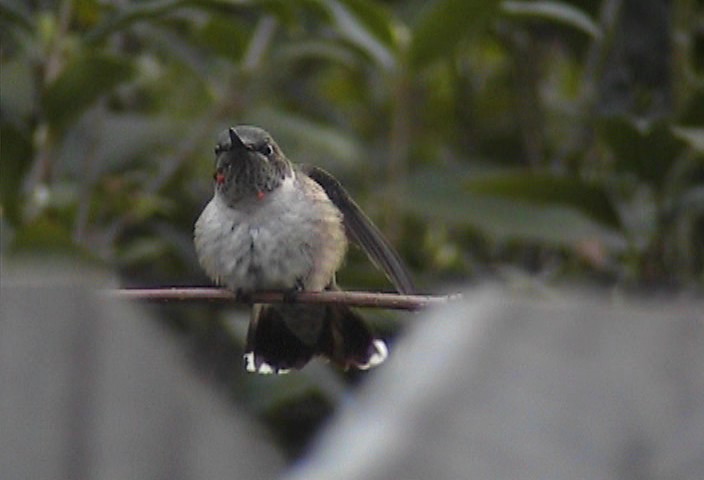
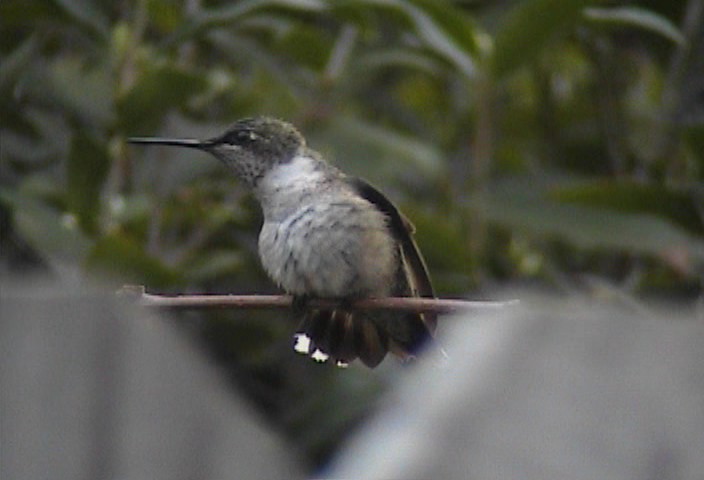
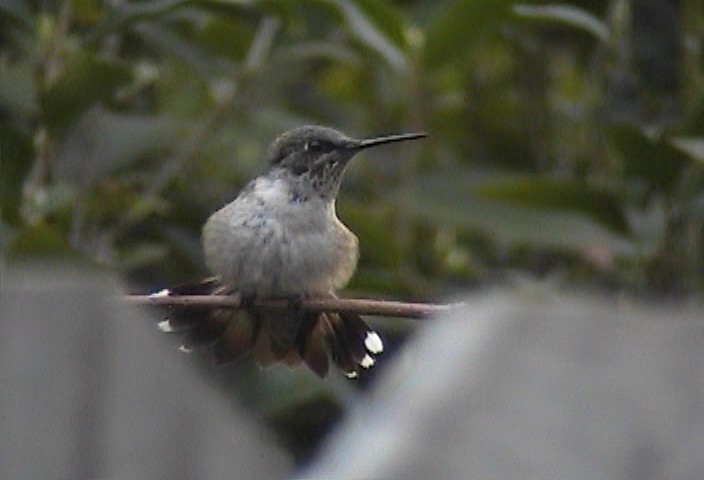
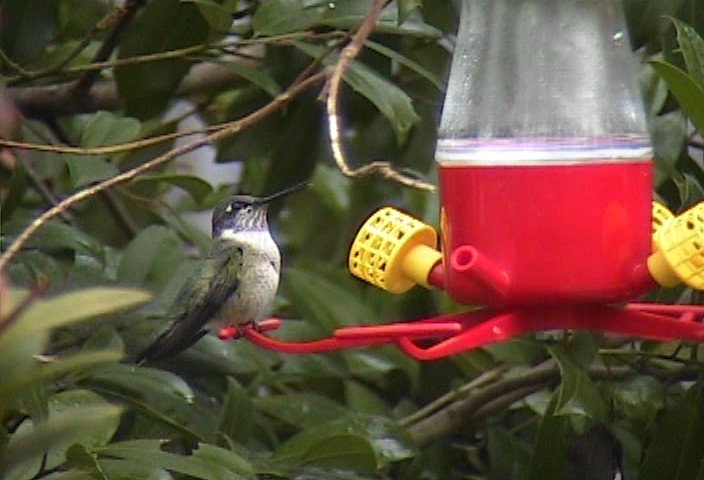
I aimed my birdcam at a hum feeder in the backyard for a few days after I noticed I might have a new hummer... I could swear I saw a male Rufous/Allen's! Two of them spent the winter with me last year, but neither returned this year. On Sunday though, I saw a little rusty male fending the ladies of the backyard feeder. So I set up the camera hoping I'd catch a glimpse of him. No luck. But I do think I have at least 3 birds using that feeder.

The first one I seem to be sharing with my neighbors the Piersons. The bird is banded and was caught and marked in their yard this year. They live about 1/2 block a way (as the hum flies). Not sure at this point if she's new this year or was a returnee from another year. (click on each picture to see a larger version)


The second one is not marked, and you can see a dark spot on her back where the feathers are imperfect. Her coloring seems a little rustier overall.

The third one has a perfectly feathered back, no mark on her head, and she's very uniformly green.

It might also be possible to tell the birds apart from the front by looking at their gorgets but I don't know that I'd be able to match the fronts and backs of the birds!

I am going to put the camera up at one of my other feeders tomorrow to see if I can figure out if I have more birds. I've found one thing that helps is that I put scotch tape over the ports on the side of the feeder away from the camera so they can't hide from me!

Sunday, February 24, 2008

Another rare flycatcher in Louisiana!


so we went twitching today. Evidently in Britain when you chase a particular bird it's called "twitching". We chased after the Fork-Tailed Flycatcher that was found in south Louisiana. I'm not sure if it's the second record or the fourth record, but either way, it's a bird that does not belong here. It's native to either southern Mexico, Central America, or South America. Apparently this one got going the wrong way, found a bunch of other flycatchers to hang out with and is visiting us for a while. It was found with 17 Western Kingbirds and a Scissor-tailed Flycatcher. Nice :-) Thanks to Winston, Karen, and Bob for making the twitching trip, and thanks especially to Bob for this nice photo.


Here's a video that shows the bird up close and personal

And some links to other pictures taken by Beth Wiggins

http://imageevent.com/bethann1952/forktailedflycatcherothers

Monday, January 28, 2008

A tale of Two Flycatchers.

The First Flycatcher
Little Gray and Brown Bird

This past weekend was the Winter Louisiana Ornithological Society Meeting. The location was Alexandria, in central Louisiana. The standard protocol for the meetings include a reception and program Friday night, field trips on Saturday, and a banquet on Saturday night. Sometimes there are organized trips on Sunday morning as well. This particular meeting had several organized field trips with assigned guides -- actually more organization than I recall at other LOS meetings I've attended. So we signed up for Sat morning and afternoon and Sunday morning trips. And then the Gray Flycatcher came to town.

In the week before the LOS meeting, some astute birders in north Louisiana happened to notice a little Empidonax flycatcher that didn't quite fit the mold. Pictures were taken, discussion was had, and the conclusion was that this was a new State bird! A record--first Gray Flycatcher ever recorded in the state! The bird was located outside of Bossier City in north LA -- two hours beyond Alexandria for those of from Baton Rouge. How could we pass up the opportunity to see this bird?

Well, we couldn't. So my compadre Lainie and I headed out to see the bird on Sat morning -- foregoing the organized field trip. Took about 2 hrs to get there, and we spent another 2 hours locating the bird, filming the bird, and noting the other birds in the vicinity for the Winter Bird Atlas. Filming the bird involved entering the cow pasture, complete with suspicious cows, lots of cow patties and very damp fields. (I'm not sure permission has been obtained by birders to enter the property, so if you do, exercise caution and, whatever you do, don't leave the gate open!) The bird tends to work a short treeline -- sallying back and forth between small trees and even out to the field to perch on twiggy growth. He's being harrassed by Phoebes and Mockingbirds, but I saw him go after the Phoebe too, so it's a two way street!

Here's a link to a series of photos taken by the Boslers when they found the bird this weekend: Bosler's pics of Gray Flycatcher

I was also able to obtain some video of the bird. Now, something I failed to mention about the Saturday that we chased the bird was that it was COLD -- a very chilly, gray day. The landscape was very gray and brown...which made it very tough to photograph a little gray and brown bird! The camera doesn't seem to be able to distinguish the bird from its surroundings and focus on the bird. So...the videos are not great. There's one 2-second stretch near the end when the bird was only about 20 feet from me that's probably the best.

Video of Gray Flycatcher

The Second Flycatcher
A Bright Vermilion Bird!

The color vermilion is not used a whole lot. I'm sure people have trouble spelling it, and why use "vermilion" when "red" will do? Well, this little bird gives one a reason to use the word vermilion! There were dozens of Northern Cardinals in the immediate area of this bird, and I bet if he hadn't been there, people would have been impressed by the red birds. But the Vermilion Flycatcher puts them to shame -- he seems to just glow and reflect light! In fact, the homeowner who lives just across the street from the location he's chosen to over-winter remarked that she thought she'd been seeing a bit of contractor tape caught in the shrubs!

While this is not a rare bird, it's much more common in the southwest corner of Louisiana. According to the folks that found this bird, Vermilion Flycatchers have been found to overwinter in Central LA in small numbers. This one hadn't been reported yet though. If you want directions to find the bird, send me an email and I'll help you out...


And now...enjoy the
Video of Vermilion Flycatcher


And more finches!


I tried my new birdcam to capture pics of the Goldfinches. I made a couple of strategic errors. I now have 1908 pictures of Goldfinches from just over 1 day of photography! There is such a thing as too much of a good thing.

Lessons learned:

If you know you're going to get lots of pics (and I pretty much expected that they'd be there till the Thistle ran out!) don't set the exposure for every 10 seconds! The camera gives the flexibility for longer intervals...use it.

10 seconds is not really 10 seconds. It seems to take a pic every 12-15 seconds as evidenced by the timestamp. Interesting. Is it detecting the motion and then waiting 2 seconds to click the shutter? Or after it clicks, does it wait 2 seconds to reset its timer? Don't know how I'll figure that one out.

1900 pictures is a LOT of pictures to have to look through to find the "good" ones!!

Don't try to cheat and get too much on camera. I have two sets of thistle feeders and a hum feeder within view of the camera. Thought if I set it up to see all 3 (even tho I thought hum feeder was too far away for clear focus...and it is) I'd get some interesting shots. Instead I have 1900 shots that I wish were better composed. You can see most of one thistle sock on left clearly....and some of more distant socks on right...center of frame is blurry hum feeder and a safflower feeders. I need to make up my mind where I want to aim the camera and don't get greedy!

Goldfinches start early and end early! They arrive shortly after dawn, but seem to quit feeding by mid-afternoon. The last pic with birds in it on Fri was at about 3:20pm. There was still plenty of light for another 2 hours (those feeders are on the west side of the house) but there were no pics. Things picked up again on Sat morning at 7:06a.m.

Goldfinches can go through a lot of thistle! Lots debris on the ground...is it Thistle hulls or whole seeds? Overflow birds will pick through it, so I suppose there's whole seed. Lots of waste. Thistle is pretty expensive, so I'm kinda glad I'm not feeding them this way year round!

I liked this picture because unlike most of the others, the goldfinches are all looking at the camera!

My new toy -- NovaBird bird cam


I got a new toy for Christmas. I actually got one for my dad, then decided he couldn't have all the fun, so ordered one for myself as well.

It's a 3MP camera mounted inside a waterproof housing with a motion-sensitive trigger. It also has nice features like a counter, the ability to date/time stamp your photos (or not, as you wish), a weatherproof battery pack, and a tripod mount. It does not come with an SD card, so you have to add your own. I'm sure that help keeps their cost down. I priced and compared motion-detection wildlife cameras (used mainly by hunters) with this and this was a good value for the money.

So...once you get it, you charge the battery pack for 24 hours. This is probably one of its detracting features...each time you recharge it's recommended you do so for 24 hours. Of course their solution is to buy a second battery pack. You set the time and date (instructions are pretty straightforward) and insert the SD card and turn it on. You also have some control over how often it takes pictures...10 seconds is the default but there are toggle switches for about 8 different settings.


For ease of moving the camera around, I mounted it on an extra tripod I had. I set it up the first time near one of my hummer feeders. Because the hum feeder was on a hook that swayed in the breeze, I got quite a few pics of an empty feeder. I deleted those, so I'll spare you :-) I then moved a feeder to the top of a pole and pointed the camera at that. Still got some "empty" pictures, but got a few good ones too. This is a series, so the bird stayed quite a few seconds to be photographed multiple times. Click on each picture to see the real detail!


Monday, January 21, 2008

Finches!


Goldfinches have arrived! I've had a trickle for the past month or two. One thistle feeder was sufficient, and it barely got any action. But this past week -- look out! They must have exhausted all the natural food supplies and started looking in people's yards. I added two new feeders. I like the thistle socks better -- easier to fill and can accommodate more birds as they just jostle for position. Unfortunately they also lose a lot of thistle, and it's not cheap! I'd like to say the doves do cleanup, but they must have better things to do around here, because the thistle on the ground appears to be going to waste...

My neighbors a mere half a block away have had Purple Finches in their yard at least the past 2 years. This year they reported the numbers of PUFI had gone up. Well, they found my yard. If you look closely in the picture you can see the Purple Finches on the plate type feeder hanging on the right. There are a couple of males, but mostly females. (Click on the picture to see a larger image)

Sunday, January 20, 2008

Eye-talian Birds!


My daughter Adrienne and I just returned from a two-week trip to Italy. We picked up a rental car in Rome, drove to Florence, Venice, and Bologna and then back to Roma, with 2 or 3 night stays at B&B's in each city. Nice way to see the country. I think we got to do pretty much everything on our agenda. It occurred to me too late to try to do some birding while I was there. I found an Italian birding guide in the Venice area and contacted him about going on a field trip. Unfortunately I would have had to dedicate a whole day to it, and we just didn't have the time to spare. However, I did take a pair of binoculars with me and if I just *happened* to see a bird, well I did my best to make note of it and try to ID it. So I probably have a European bird list of 20-25 birds. I haven't figured them all out yet, but when I do, I'll list them here.

If you look closely here (lower left) you can see some ducks...Italian Mallards!

Monday, November 12, 2007

It's always a good day when you see an eagle

Did you know that Bald Eagles are one of the few birds found in all states? Maybe not Hawaii...I'll have to check on that. They nest here in Louisiana in the winter. An eagle is always an impressive sight. I saw this one down at the river by the Vet School right near the LSU campus. He perched and posed and then headed off upriver. A little later a younger bird flew by, scanning the river for fish.

Bald Eagle at the river

Sunday, November 11, 2007

There aren't many cuter birds...

Can you find the bird in this picture?? The Winter Wren is a tee-nincy little bird. Most wrens are ground dwellers and this one is no exception. If you think you see a mouse and it turns out to be a bird, it could be a Winter Wren. This one was enjoying itself at Bluebonnet Swamp last Sunday.

Winter Wren at Bluebonnet Swamp


We don't get much of a fall here, so we have to enjoy any spots of color we can find...
This beautiful flower is a form of orchid called "Lady's Tresses" and it grows wild in the swamp...

Saturday, October 20, 2007

Cool Birds you can find around Baton Rouge


This month's Birding with the Family class was entitled "More than Wal-mart Birds" or.... "Cool Birds you can find in/around Baton Rouge". The turnout for the class was light, only 5 folks, and no kids :-( But it was fun nonetheless. Keri and I "tag-teamed" the material, which worked out well. But the pressure was on for the field trip... With a title like "Cool Birds" I was pretty much under the gun to show these folks some cool birds! So we started down at the roost at City Park lake at dawn. Had a good showing... Great Blue Herons, Great Egret, Snowy Egret, Cattle Egret, Little Blue Heron, Tri-colored Heron, Double-crested Cormorant, and even a Green Heron and Black-crowned Night Heron to boot! Then we went to Bluebonnet Swamp. John H. was there to let us in early and also show us where the owls hang out. He's seen two Barred Owls hanging out consistently (Barbara and ??) and the Great-Horned Owl he's nicknamed "Harvey". Unfortunately, Harvey didn't show up, but Barbara showed up for us and posed for quite a few pictures. Nice!

The annual Big Sit

From The BirdWatchersDigest.com website: "THE BIG SIT! is like a Big Day, or a bird-a-thon in that the object is to tally as many bird species as can be seen or heard within 24 hours. The simplicity of the concept makes The Big Sit! so appealing. Find a good spot for bird watching -- preferably one with good views of a variety of habitats and lots of birds. Next you create a real or imaginary circle 17 feet in diameter and sit inside the circle for 24 hours, counting all the bird species you see or hear. That's it. Find a spot, sit in it, have fun."


So, we did :-)


Justin and Devin Eby-Bosler have done the Big Sit for the past 2 years in Baton Rouge close to the banks of the Mississippi River. This year they had the most participants, but unfortunately the lowest number of birds. Still it was great weather, and good birding company, so a worthwhile effort. There were some new birds this year, which is always fun.


Look, I actually got a picture of Lainie with her bins in her hand!
For a full report of the day, including a list of the 75 species we saw, visit:
http://birdingonthe.net/mailinglists/LOUI.html#1192568394


Justin, Devin, Richard, Lainie, Lindsay, Harriett, and Sue -- Let's do it again next year!

Monday, October 01, 2007

Backyard visitor

Yesterday my dad commented that our backyard was like a Disney movie...all the little animals romping and cavorting in (nearly) perfect harmony. Well today would have been the arrival of the wicked witch. I opened the door to a quiet yard and then movement caught my eye. Cooper's or Sharp-shinned...I'm not sure which...but this hawk was after the happy little creatures in the yard. It made several attempts to get the squirrels, but didn't get one while I was watching. Quite an impressive bird...

Sunday, September 23, 2007

Kinda gross, but...

Recently at the Hummingbird and Butterfly festival, the speaker explained that butterflies that congregate on mudholes to glean minerals they need to reproduce. While birding at a place on the river, I came across these butterflies doing what I assume was the same kind of gleaning on some coyote scat. Kinda gross but interesting...

Back to the river...


Went back to the river to another location...also a sand/silt place but farther down toward St. Gabriel. Birding friend Sue Broussard knows the owner. It's a large property, quite overgrown at the moment as it's not a working dirt concern at the moment. Roads were hard to find at times, overgrown with grasses. It was also pretty muddy from the previous day's rain--and let me tell you, river silt makes a really sticky mud! We thought the birding would be excellent as there has been little human intervention in months, but it was rather slow. We had a nice group of Wood Storks - I think we counted 32 in all. Also came across a Nashville Warbler and a group of a dozen or so Yellow Warblers. Lots of Indigo Buntings in their drab brown fall garb, and lots of Painted Buntings, but no males today to ooh and ah over. Sue did have her hair parted by a Barred Owl, so that was kind of exciting!

Saturday, September 22, 2007

Ever wonder how a hummingbird takes a bath?

I've created a hummer perch outside my kitchen window for the hummingbirds to sit on and guard the nearby feeders. Today it rained a bit as the fizzling tropical depression passed over. I looked out and saw this hummer bathing in the rain as it perched on the twig -- it sure looked like it was enjoying itself!

Hum Bathing

(sorry about the football soundtrack in the background...the LSU game was on, what can I say??)

Local birding @ Richfield Riversilt

Decided to try for migrant warblers on the river front this morning. Not much luck. Best birds were 6 WOOD STORKS flying over and a beautiful male Painted Bunting (obviously video wasn't taken today, but I can't pass up an opportunity to show it off :-)). Ruby-throats fighting over lantana! South end of property has lots of standing water -- enough that a couple of fisherman were trying their luck. Few shorebirds present. North end of property was VERY overgrown. I pushed through the giant ragweed and emerged covered in yellow pollen--definitely not recommended for those with allergies! Got a nice video of a Northern Waterthrush -- Sibley's Eastern Field Guide nailed this
description. It was seen foraging near standing water and its tail was pumping to beat the band: Long version or Shorter version

Took Ben Hur on the way home. Had another Wood Stork flyover there. Also observed 3 Am. Crows lunching on what appeared to be a juv. Bluebird :-(

Sunday, September 16, 2007

The Hawks vs the Crows

So my thought was that I'd start a website and maintain that instead of updating this blog. However, what I've found is that even tho I like the website and want to have for basically static information, I still need an easy way to give updates. Blogger is easier than the website update process. So...I think I'll maintain this blog and link the two together.

On that note...there's no way I can catch up with all the birding events of the past 5 or 6 months. Instead, I'll just start fresh.

Last weekend I went to Hooper Road park in Baton Rouge (a BREC park in Central, which is in north Baton Rouge near the Airport). The park has horse trails! I don't think they're used much, but it was neat to see. Also has bike trails and one labeled walking trail but I really couldn't find that one. The park also has a rec center and a couple of baseball or softball diamonds. I bet they're used, but not at 7am on a Sat. When I emerged from a trail in the woods, I noticed movement near the ball fields. The ball fields are back to back with bleachers that are back to back as well. On one side of the bleachers sat a half dozen crows. On the other bleachers sat two hawks...my best guess is young Cooper's Hawks. They weren't quite as large as the crows....but they decided they wanted to eat crow! The'd fly over into the mess of crows, who would barely dodge out of the way, occasionally flying up in small circles to avoid the hawks. The hawk would land, sometimes right to the crows, and then try again. If I can anthromorphize a bit, the crows looked either bored or patronizingly amused at the effort of the hawks....and there were no feathers flying! The young hawks caught sight of a fox squirrel, and oh boy they're on it. It managed to elude them first by going to the back side of a telephone pole (where did he go? where did he go?) and when it got back on the ground, it went on teh other side of the chain link fence of the ball field. The hawks flew into and landed on the face of the fence a couple of times trying to figure out how to get to the squirrel. They finally gave up and went back to harrassing the crows. An adult Red-Shouldered Hawk came in at one point to see what was going on...it made a lazy pass at the crows once or twice and then gave up and moved on.

I did take video, but I was some distance away so I'm not sure what you'll be able to tell. I didn't get too close for fear of upsetting the interaction. It was an amusing exchange and certainly made my day!

Wednesday, April 04, 2007

Little Ruf and the Stranger

Every day I hang around the kitchen window from about 6:45 to 7:45 both am and pm waiting for my little Rufous to show. This evening as I was preparing dinner I looked out on the perching branches above the feeder and there was a stranger there. A green-backed stranger. I grabbed the binoculars and got a bead on him...green back all right, but didn't have the emerald quality of a ruby-throat. And then he turned his head...gorget not fully developed...and a flash of pink! pepto-bismol pink....as in a pink paint mark! I was remarking all of this out loud to my husband and the words, "he had better watch out because the Ruffie is coming" no sooner came out of my mouth when SLAM the Rufous came down on the pink-marked bird and knocked it off the perch. I was looking through the binoculars at the time, and it was pretty spectacular! The Ruffie went to the feeder like he owned the place and then flit! he was gone. A few minutes later I saw a very skittish pink-marked stranger at the front yard feeder. He ate and then hid in the middle of the crape-myrtle tree. A mature male ruby-throat showed up at the feeder, but pink-mark didn't even challenge him, he just stayed hidden.

Here's a shot of Ruffie extracted from the video...unfortunately from the back as he sat at the feeder


And a bit of video of the stranger as he hides. If anyone's missing a pink-marked bird let me know!I couldn't tell which leg he's banded on, but maybe he'll be here tomorrow

Click here to see the Stranger

Sunday, April 01, 2007

The cutest couple

Downy woodpeckers have become regulars at my suet feeders over the past year. But it was a special treat to have a pair of them, male and female, at the feeder recently. I presume they are nesting in the area, because they visit regularly, often together. That may change when the babies come!

See the cute couple by clicking here

A crown fit for a King...let

The Ruby-Crowned Kinglet is a common bird around here during the winter. They're tiny birds and they flit around so quickly they are hard to see with binoculars, much less with a camera. And most of the time it's hard to tell why they are called "ruby-crowned" because there's not sign of any red at all. Their crowns become apparent when they get riled or agitated.

I got really lucky and was able to keep the kinglet in view long enough to get some great close-ups, AND he's got his crown up!

Ruby-crowned kinglet flits and displays

Long time, no see!

Well, I've had at least 3 people tell me they missed updates to my blog, and I realized it's been MONTHS since I updated anything...so here's some stuff!

I just reviewed the videos I've taken over the past few months. I don't think I'm necessarily going to post them in order...I'll just tell a bit about each one as we go...

This outstanding video was from a lucky day at Bluebonnet Swamp. I arrived before 7am for the monthly Bird Walk, but the gates were closed. Two other ladies, Janet and Jennifer, were there, so we decided we weren't going to let a closed gate stop us. We used the "east entrance" and made our way down the boardwalk. As we came to the main boardwalk, two gentleman were there putting away their cameras. They told us about a Barred Owl that had been posing for them just off the boardwalk. He'd hunted, posed, preened...they had so many great pictures they were packing it in and going home, cuz it couldn't get any better. We were so sad we missed it... they moved out, we moved on...and then lo and behold...there he was again!

Here he is, in all his swively head glory

Click here to see the Barred Owl hunting and preening

Saturday, January 20, 2007

Had a Buff-bellied treat today!


I missed the Winter Hummer Tour last weekend. One of the homes featured a Buff-bellied Hummingbird, which is one of the birds I have yet to get a good video of. Tried last year but had little luck. This bird was rumored to be cooperative, and I'll have to agree! Took me about an hour to get reasonably close, but I'm pleased with the results. Many thanks to the Hansens for letting me hang out in their yard today!

The Buffy obviously has some favorite perches, so I tried to blend in and ease close. This video was the end result of about an hour and a half of effort and is from the last set I was able to get. He seemed to have relaxed and allowed me to get within about six feet. I love this shot where you can see the bright green flash of his gorget.

Flash o'green


The bird obviously had a Guardian Squirrel -- this little booger called the alarm for the whole hour I was out there! What's cool is that you can hear the Buffy talking too -- he makes a click, click, click and a squeak. And then of course he'll cuss when he's defending the feeder -- although he didn't have much competition today. The Hansens have a Calliope visitor too and he snuck in a couple of times for a sip -- the size difference between the birds was pretty amazing!

Buffy Talk

At one point he got aggravated with me I think and ducked down into some low cover to hide. I was persistent though. I didn't think these shots would come out as well as they did since I had to shoot through the twigs and sometimes that fools the auto-focus eye of the camera. But the colors were especially nice at this angle.

Buffy in a tangle

And here's another action shot...just 'cause

Action shot


What fun!

Sunday, December 31, 2006

Ever heard a Blue Jay imitate a Red-Shouldered Hawk?

How well can a Blue Jay *really* imitate a Red-Shouldered Hawk? Caught these two on video today. Thought the Hawk was flirting with another hawk til the Jay showed up!!

http://dgpatterson.com/janebirds/JayvsRSHawk.wmv

10 feet tall and bullet proof!

Had a visitor to the yard today….a beautiful Cooper’s hawk! Needless to say, every bird in sight disappeared instantly…except for the juvie male Rufous hummer who guards the end of my driveway. He was divebombing the hawk if it moved, and cussing at it incessantly for as long as it was there. Fortunately it had its eyes on other things (house sparrows) and couldn’t be bothered with this tiny feisty morsel!

The dive-bombing in this video doesn’t show…but you can hear him cussing in the background (turn up the sound, but cover any tender ears in the room—such language, tsk tsk!!) http://dgpatterson.com/janebirds/CoopVsRufous.wmv

And here’s a closeup of the tough guy. Does he look 10 feet tall and bullet proof to you??? http://dgpatterson.com/janebirds/rusty_hum_side_good.wmv

Friday, December 29, 2006

They do eat bugs, they do, they do, they do!


There were some postings recently on humnet (listserv for humnuts) regarding whether or not hummers are flycatchers to any significant degree. I don't think there's really a debate...I believe it's been ruled by examining stomach contents that they are, but it's rare to actually witness them at it. I was watching this little hummer today -- he's an overwintering juvenile male Ruby-Throat --and I caught him in action! You can even see the insect he's after! Some times it pays to be patient :-)

The short version of the video: http://dgpatterson.com/janebirds/Hum_Flycatching_short.wmv

The longer version of the video: http://dgpatterson.com/janebirds/Hum_flycatching.wmv

And a neat short clip of a great stretch and tail flare… http://dgpatterson.com/janebirds/R2_tail_flare.wmv


Sunday, December 17, 2006

Sorting out winter hummers...

I'm trying to sort out the hummers that have visited me so far this winter, or at least the ones I've managed to photograph. There appear to be six distinct birds:

#1 - The first winter bird was an adult female Sel R/A with a distinct triangular gorget and a lovely bracelet on her left leg. Since Nancy banded two female Rufous here last year and she bands on the left leg, it stands to reason she is a returnee. Hope to confirm that at some point. She’s the only one that I’ve confirmed is banded – thought I saw a band on one of the others, but when I view the video I can’t see it. http://dgpatterson.com/janebirds/Rufous_banded.wmv

#2 - I have another Sel R/A that has a LOT of rust-color on it. The gorget is smaller compared to the other Sel R/A birds. http://dgpatterson.com/janebirds/rusty_hum_side_good.wmv http://dgpatterson.com/janebirds/rusty_back.wmv It’s not an adult male Rufous though… but it has a lot of rust for a female. What do you think?

#3 – I am pretty sure this is a third Sel R/A. The coloring and the gorget looks different to me than my #1 bird. Also see no evidence of band. http://dgpatterson.com/janebirds/3rdRuf_close.wmv

#4 – I observed #4 and #5 on the same day. Or rather…I knew I had a bird that was not a Sel R/A but I hadn’t sorted it out yet. When I did manage to get a picture, two birds showed up! I call #4 “Fatty” because it’s, well, fat. J It also has a single reflective gorget feather to the lower right so I’ve been able to ID it by that (not definitive, I know, but raises probability with so few birds around). I think it might be a Ruby-throat, although it’s the mildest-mannered one I’ve seen. Twice I’ve seen it allow other birds on “his” feeder. His feather’s get ruffled but he rarely rants or take action. Very laid back bird, for a hummer. http://dgpatterson.com/janebirds/driveway_hum2.wmv

#5 – First observed this bird when it visited the feeder that #4 was guarding! He has a distinct 5-oclock shadow, but no reflective feathers in it that I can see. http://dgpatterson.com/janebirds/hums_4and5_121306.wmv This is a closer look at just #5 http://dgpatterson.com/janebirds/nonRuf_shadow_VG.wmv

#6 – This last one is definitely not a Sel R/A, nor is it the same bird as either #4 or #5 because her throat is completely clear – no shadow or gorget feathers in sight. I’d say she’s either a RTHU or a Black-chinned. http://dgpatterson.com/janebirds/clearthroat_good.wmv